23 people live in Goldcoast, where the median age is 72 and the average individual income is $56,216. Data provided by the U.S. Census Bureau.
Total Population
Median Age
Population Density Population Density This is the number of people per square mile in a neighborhood.
Average individual Income
The Gold Coast is Ocean City's marquee address — the prestigious stretch running roughly from 18th Street to 34th Street, bounded by the Atlantic to the east and Central or West Avenue to the west. It's the part of the island where wide, pristine beaches meet block after block of high-end coastal duplexes and generational beachfront estates, all without the boardwalk traffic, amusement parks, or retail noise that define the northern end. The result is what locals call the "quiet premium": strictly upscale, strictly residential, and deliberately peaceful.
The neighborhood draws a particular buyer. These are affluent families from the Philadelphia, New York, and North Jersey metros chasing a generational beach home, lifestyle investors who want a luxury asset that carries its own mortgage, and high-net-worth buyers migrating into the island's top tier. Ocean City's dry-town tradition — no bars, no liquor stores, no nightclubs — shapes the entire atmosphere into something safe, family-first, and calm. People buy on the Gold Coast precisely because it pairs serious coastal luxury with serious tranquility.
The Gold Coast has long commanded premium pricing thanks to its wide beaches, residential quiet, and dense concentration of luxury stacked duplexes. Over the last several years it rode a wave of substantial capital appreciation. The island-wide median sale price now sits comfortably above $1.08 million, but the entry baseline inside the Gold Coast pocket runs significantly higher.
The market has since shifted into a more selective, stabilizing phase — though it remains firmly a seller's market because of a structural supply crunch. A few dynamics define the current pulse:
For investors, the Gold Coast demands substantial capital but delivers blue-chip security. The strategy here is less about chasing yield and more about owning a finite, appreciating piece of premier barrier island.
Where the Gold Coast shines brightest is short-term vacation rentals. As the heart of "America's Greatest Family Resort," it's a prime destination for weekly summer tourists, and large four-to-five-bedroom first- or second-floor ocean-view condos command astronomical weekly rates from late June through August. The catch is the steep cost of entry, which compresses cap rates relative to cheaper markets. But the sheer velocity of summer booking fulfillment minimizes cash-flow risk — in practice, a Gold Coast rental functions as a wealth-preservation and lifestyle asset that carries its own mortgage rather than a high-cash-flow machine.
On appreciation, the Gold Coast behaves almost like a beachfront index fund. The land footprint is finite, hemmed in by the ocean and the wetlands, so there's a hard ceiling on supply. As long as affluent buyers from the major Northeast metros keep seeking generational beach homes, capital appreciation in this zone should continue to outpace mainland trends.
For development, the traditional fix-and-flip is rare because raw teardown lots are so expensive to acquire. The dominant play is teardown-and-rebuild: investors buy an aging single-family or outdated duplex on a prime lot, demolish it, and construct a modern duplex with elevators, rooftop decks, and high-end coastal finishes. Recently, appetite for brand-new construction has been intense, with buyers often committing pre-construction before the drywall is up. For those with the capital and the local builder relationships to navigate Ocean City's strict zoning, building new duplexes for immediate resale yields substantial margins.
Buying in Ocean City's premier neighborhood requires a swift, aggressive approach. This is a heavily capitalized market with scarce inventory, so the process looks nothing like a standard suburban purchase.
Cash carries real weight here — a substantial share of Gold Coast transactions are all-cash deals, with buyers leveraging private wealth or equity from primary residences to bypass mortgage delays. Many of the best properties also change hands quietly through pocket listings and brokerage networks, so by the time a home hits the public MLS it's often already under intense scrutiny. For turnkey new-construction duplexes or prime beachfront single-families, expect immediate competing offers, escalation clauses, and the need to lead with your highest-and-best number from the start.
Because sellers hold the leverage, standard contingencies get heavily scrutinized:
As for what you'll actually be buying, the Gold Coast centers on two property types. The multi-family duplex is the neighborhood staple — stacked condos where one owner holds the first floor (usually a three-to-five-bedroom unit) and another holds the second (often with vaulted ceilings and a rooftop deck). The custom single-family mansion sits at the top of the market, positioned on the beachfront along Wesley Avenue or one block back — massive, multi-million-dollar generational estates with elevators, multiple decks, and high-end coastal finishes.
The rent-versus-buy question on the Gold Coast comes down to a math problem weighed against your long-term goals. The price-to-rent ratio here is exceptionally high — with values routinely between $1.5 million and $5-plus million, the income from a standard year-round tenant doesn't cleanly justify the purchase price. The crucial nuance is that this market runs on short-term vacation rental math, not traditional annual leasing.
Renting makes sense for the variable-lifestyle buyer. If you only spend two to four weeks a year in Ocean City, renting a premier Gold Coast duplex for $8,000 to $12,000 a week is far more economical — you get the peak luxury experience without property taxes, HOA fees, insurance, or winterization. Renting is also the smarter move if your goal is immediate, high-percentage cash flow; capital chasing an 8% cap rate will perform better in inland multi-family markets, since buying here ties up significant capital for a relatively low immediate net yield.
Buying makes sense as a land play and a lifestyle play. Purchasing on the Gold Coast means owning a finite piece of premium East Coast barrier island, which is the right move if your goal is long-term appreciation and passing an appreciating asset to your children. It also works beautifully for the hybrid investor: use the home yourself during the gorgeous shoulder seasons of May, September, and October, while high-paying weekly tourists cover your mortgage, taxes, and insurance through the 10-to-12-week peak summer rush.
Relocating to the Gold Coast — whether from the Philadelphia metro, North Jersey, or New York — means adopting a lifestyle defined by coastal elegance, local tradition, and distinct seasonal rhythms.
Geographically, the neighborhood runs from 18th to 34th Street, ocean to the east and Central or West Avenue to the west. The defining trait is the "quiet premium": no boardwalk traffic, no amusement parks, no loud retail — just upscale residential blocks. The dry-town culture is the other thing newcomers must internalize. With no bars, liquor stores, or nightclubs on the island, you'll either stock your own fridge or take a short drive across the bridge to Somers Point or south to Strathmere. Far from a drawback, this is exactly what keeps the neighborhood so safe, family-oriented, and peaceful.
The seasonal swing is dramatic. From Memorial Day to Labor Day, the neighborhood fills with energy — packed beaches, streets alive with bikers and walkers, and parking at a premium. After September, the Gold Coast transforms: the weekly tourists vanish, leaving a tight-knit community of year-round residents and weekenders. Many locals consider the crisp, quiet shoulder seasons the very best time to experience the place.
On logistics, year-round families are served by the highly rated Ocean City School District, and a large Acme supermarket sits right on 34th Street at the neighborhood's southern border, so essentials are never far. The 34th Street Bridge (Route 619) connects directly to the Garden State Parkway, making trips to Atlantic City's airport or back to the Philadelphia grid quick and simple.
The Gold Coast's aesthetic is a masterclass in maximizing premium coastal footprints. With land values this high, the architecture is engineered to optimize ocean views, natural light, and outdoor living.
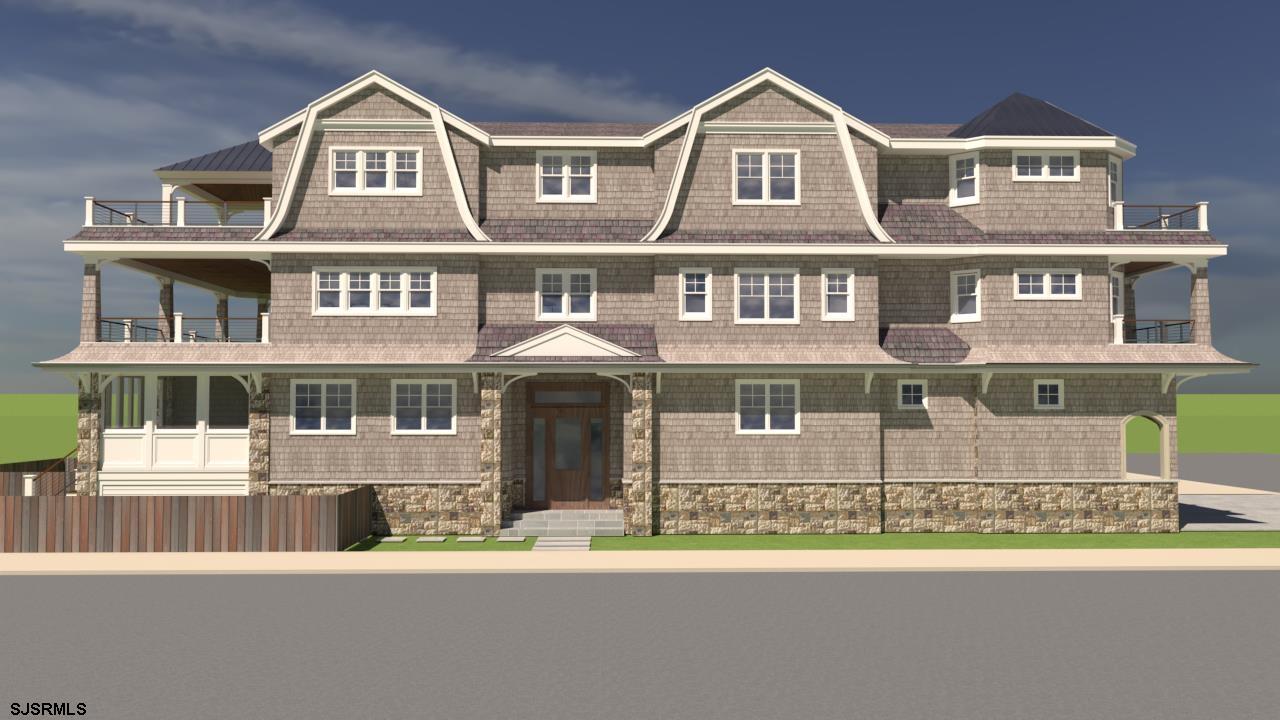
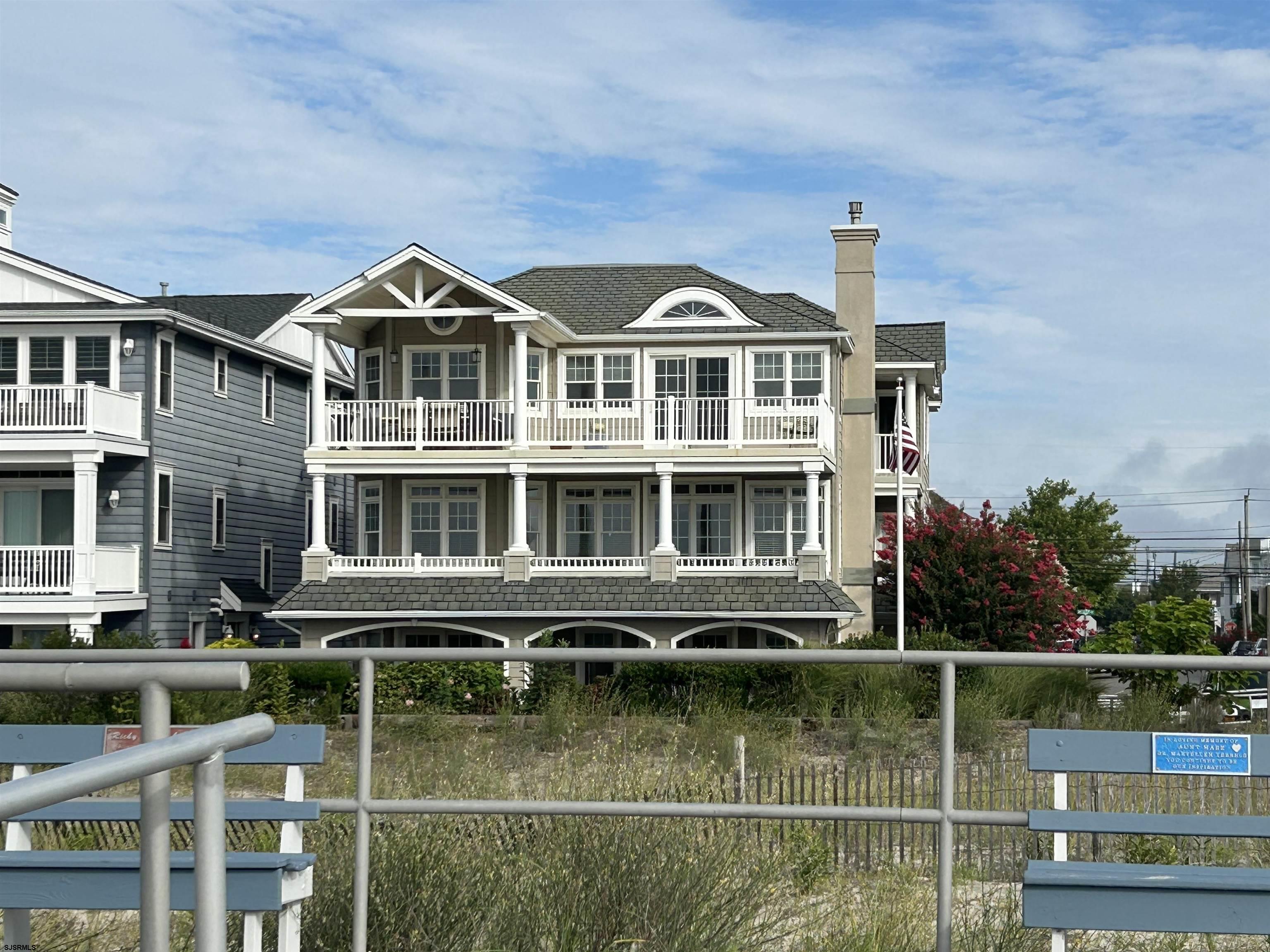
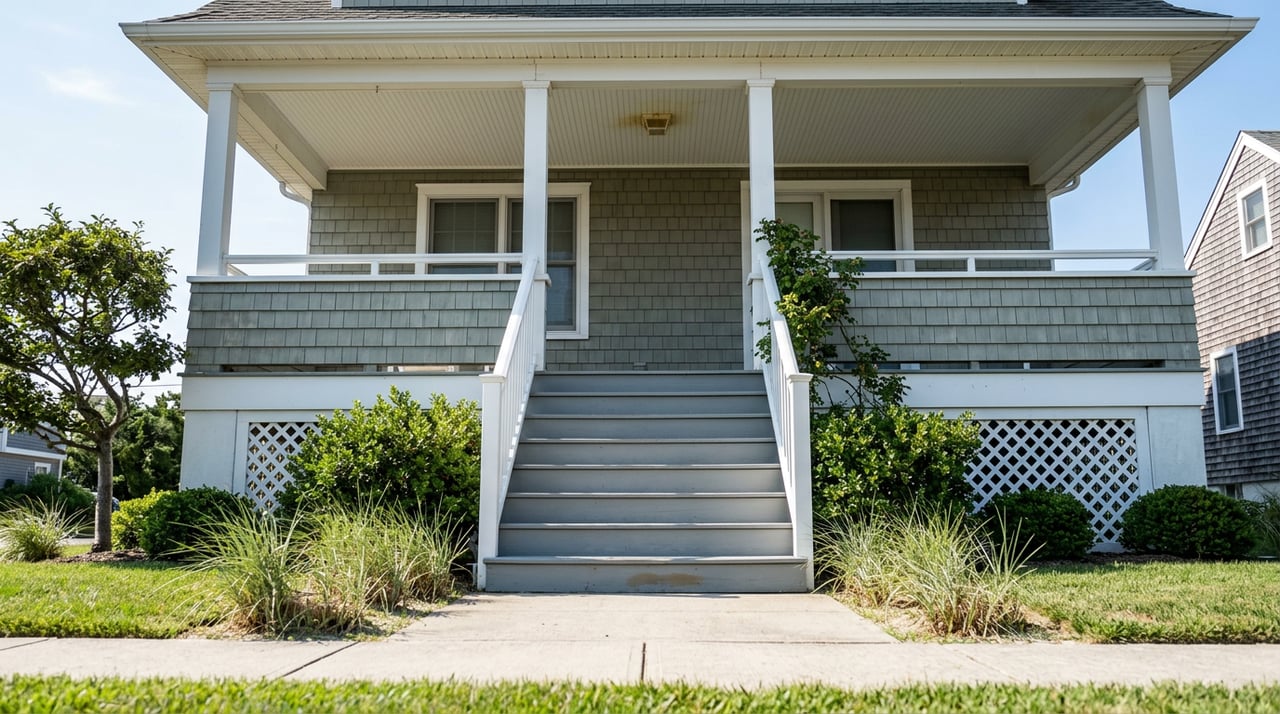
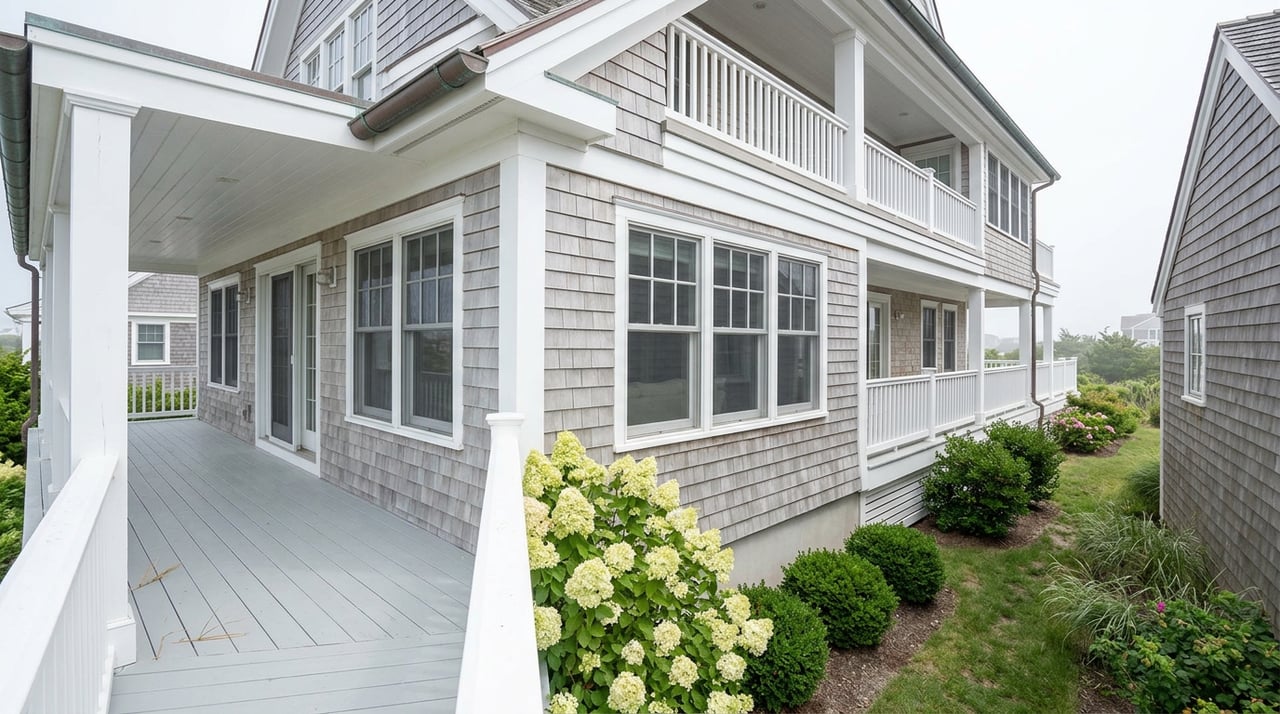
The dominant style today is the upscale modern Coastal Craftsman, or Cape Cod Revival, built beautifully into stacked duplexes. Expect HardiePlank or cedar-shake siding built for harsh salt air, crisp white trim, A-frame gables, and generous covered front porches. In the typical vertically stacked layout, the first-floor unit gets a wide ground-level porch while the second-floor unit boasts vaulted ceilings, clerestory windows to capture morning light, and a private staircase to a rooftop deck with panoramic ocean and island views.
Along Wesley Avenue, the oceanfront street, the architecture shifts to generational beach mansions — massive custom estates blending Nantucket Shingle style with ultra-modern luxury. Here you'll see sweeping curved balconies, walls of ocean-facing glass, grand columns, and foundational pilings neatly disguised by high-end landscaping or coastal stonework. Elevators are standard in nearly all newer Gold Coast builds — essential for three-story living — and multi-car garages tuck underneath to maximize living space above.
You'll still occasionally spot a 1970s or '80s flat-roofed "cookie-cutter" fiberglass duplex, but they're disappearing fast. The clear trend favors custom designs with rich textures, soft coastal colors — seafoam greens, gentle blues, crisp whites — and integrated smart-home technology engineered to weather coastal storms.
The Gold Coast offers an appealing blend: a self-contained, highly walkable beach community that also serves as an easy launchpad for regional commuting.
Official walk-score metrics label the island "car-dependent" for major shopping, but day-to-day life in the Gold Coast feels entirely pedestrian — from almost any point in the neighborhood, you can reach the sand in under five minutes. The bike infrastructure is excellent, with West Avenue's dedicated, brightly painted bike lanes a particular favorite. In summer, bikes effectively replace cars for grabbing morning buns at local bakeries or cruising down to the boardwalk's southern terminus at 23rd Street. The 34th Street commercial corridor anchors the neighborhood's southern tip, putting a major Acme supermarket, gas stations, eateries, and surf shops within easy reach of anyone in the 20s and 30s blocks.
For getting off-island, NJ Transit runs bus service along the island (primarily Route 509), linking Ocean City to Atlantic City and mainland hubs, but the Gold Coast is really built for driving. The 34th Street Bridge connects to US-9 and the Garden State Parkway in under five minutes. From there, Atlantic City is a straightforward 25-to-30-minute drive north — viable for professionals in healthcare (AtlantiCare), gaming, hospitality, and legal sectors — while Philadelphia sits roughly 65 to 75 miles away, about an hour and fifteen minutes via the Atlantic City Expressway, very manageable for hybrid workers heading into Center City a couple of days a week.
For year-round family buyers, the school system is a major selling point. The Gold Coast is served entirely by the Ocean City School District, which consistently ranks as the #1 public school district in Cape May County and sits among the top 40 districts statewide. Because the district's tax base is fueled by premium coastal real estate, its schools are exceptionally well-funded, with a rare 10:1 student-to-teacher ratio that supports highly individualized instruction. The structure is streamlined, with students moving sequentially through three centralized campuses just north of the Gold Coast.
Ocean City Primary School (PK–3) earns an A grade from Niche and is known for its early childhood programs and an exceptionally low 7:1 student-teacher ratio that lends a private-school feel within a public framework. Ocean City Intermediate School (4–8), on Bay Avenue, bridges the gap with strong testing metrics and excellent extracurriculars, rating above state averages in reading and science. Ocean City High School (9–12) is the district's crown jewel — an A-minus Niche grade and the #1 Best Public High School in Cape May County. It's regarded highly enough to operate as a School Choice institution, drawing applicants from surrounding mainland towns, and it pairs a deep slate of AP courses and competitive STEM pipelines with a legendary athletic program that routinely wins South Jersey championships.
The takeaway for out-of-town buyers is simple: relocating to the beach here doesn't mean sacrificing educational quality. That academic strength also helps preserve property values across the neighborhood.
The Atlantic is the ultimate backyard here, but the neighborhood backs it up with functional, family-oriented recreation. The Gold Coast beaches from 18th to 34th Street are wide, exceptionally clean, and fully staffed by the Ocean City Beach Patrol in summer — and because the area is entirely residential, they feel far less crowded than the beaches up north. A protected coastal dune system runs the length of the beachfront, with scenic wooden pathways leading from the street right onto the sand.
On land, the 34th Street Playground & Recreation Complex at the southern border is the main hub, featuring an expansive modern playground, well-kept tennis courts, and popular pickleball courts. And the famous Ocean City Boardwalk reaches its southern terminus at 23rd Street, giving Gold Coast residents a seamless transition from a quiet residential stroll to a lively paved track ideal for morning jogs or oceanfront bike rides.
The social scene mirrors the neighborhood's upscale, family-first identity — relaxed, high-quality, and community-driven rather than high-energy. Because Ocean City is a dry town, there are no bars, taprooms, or nightclubs on the Gold Coast; "nightlife" here means backyard barbecues, sunset gatherings on rooftop decks, and casual walks to local ice cream parlors. The island's BYOB dining culture fills the gap, with residents enjoying the ritual of stocking fine wines on the mainland and bringing them to local eateries.
You won't find sprawling restaurant rows inside the residential grid, but the borders deliver everything you need. The 34th Street corridor offers casual dining — local pizzerias, classic Jersey Shore sub shops, and essential morning stops for coffee, donuts, and breakfast sandwiches. A short bike ride brings you to some of the island's best seafood spots, and when residents want a true bar scene, a steakhouse, or livelier nightlife, they make the quick 5-to-10-minute drive across the bridge to Somers Point, or south to Strathmere and Sea Isle City.
If you're weighing a move to the Gold Coast — or trying to decide whether to buy, rent, or invest in Ocean City's premier pocket — it helps to work with someone who has watched this market evolve firsthand. Cheryl Huber has been helping clients buy and sell in Ocean City since 1985, with three decades as a top producer and deep experience across residential sales, new construction, and development. With The Cheryl Huber Team at Berkshire Hathaway HomeServices Fox & Roach — a dedicated group of four agents and two specialty coordinators — every detail is handled with care from the first conversation through closing. Whether you're chasing a generational beachfront estate, a stacked duplex for hybrid use, or a numbers-driven investment in a high-entry market, the team's focus is on understanding your goals and treating your search as its own.
To start a conversation or ask a specific question about the Gold Coast:
Reach out whenever you're ready — no pressure, just local expertise from someone who knows these streets block by block.
There's plenty to do around Goldcoast, including shopping, dining, nightlife, parks, and more. Data provided by Walk Score and Yelp.
Explore popular things to do in the area, including 24th Street Beach.
Goldcoast has 31 households, with an average household size of 2. Data provided by the U.S. Census Bureau. Here’s what the people living in Goldcoast do for work — and how long it takes them to get there. Data provided by the U.S. Census Bureau.
Total Population
Population Density Population Density This is the number of people per square mile in a neighborhood.
Median Age
Men vs Women
Population by Age Group
0-9 Years
10-17 Years
18-24 Years
25-64 Years
65-74 Years
75+ Years
Education Level
Total Households
Average Household Size
Average individual Income
Households with Children
With Children:
Without Children:
Marital Status
Blue vs White Collar Workers
Blue Collar:
White Collar:
Explore detailed neighborhood profiles to see what makes each area unique — from amenities to nearby attractions.